What Is RAG? A Guide to Retrieval-Augmented Generation
Learn what RAG (Retrieval-Augmented Generation) is, how it works, and how it differs from fine-tuning — with a real Python code example for developers.
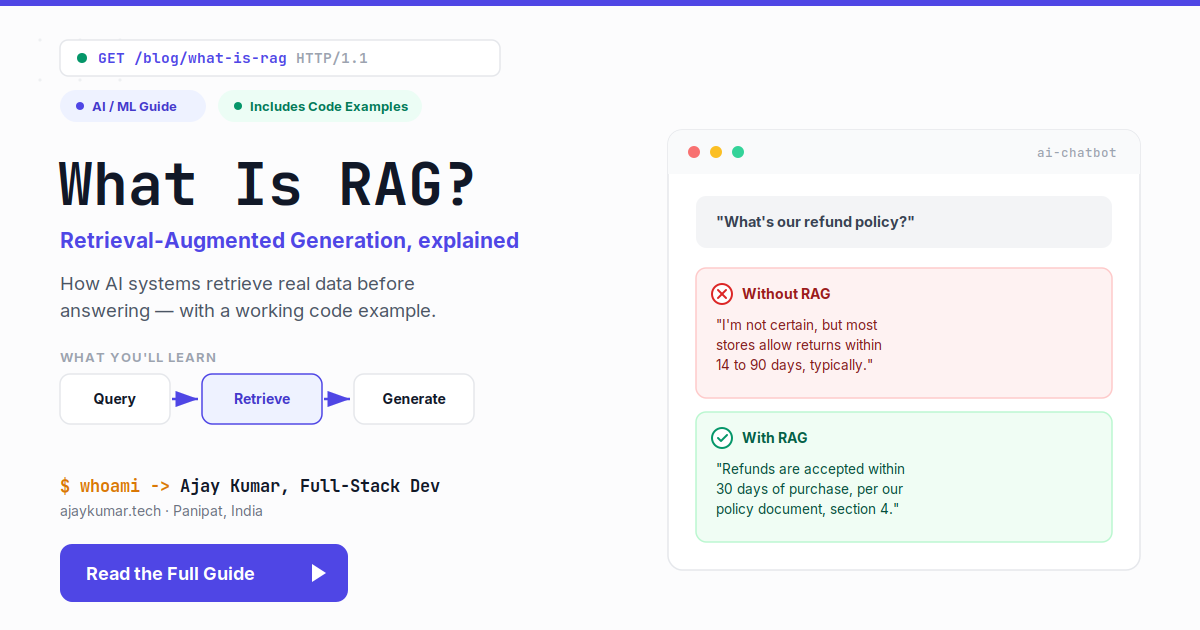
Ask an AI chatbot a question about something recent, or something specific to your company, and you'll often get an answer that sounds completely confident — and is completely wrong. This isn't a bug you can just "wait out." It's a structural limitation of how large language models work, and it's exactly the problem RAG was built to solve.
If you've been seeing the term everywhere — in job listings, AI product docs, or developer conversations — this guide breaks down exactly what RAG is, why it exists, how it actually works under the hood, and how you can build a simple version of it yourself.
What Is RAG (Retrieval-Augmented Generation)?
RAG stands for Retrieval-Augmented Generation. It's a technique that connects a large language model (LLM) to an external knowledge base, so the model can pull in real, up-to-date information before generating its answer — instead of relying only on what it memorized during training.
In plain terms: a normal LLM answers purely from memory. A RAG-powered system looks something up first, then answers using what it found.
That one change fixes two of the biggest weaknesses of large language models:
• Outdated knowledge — an LLM's training data has a cutoff date. RAG lets it access current information without retraining.
• Hallucination — when a model doesn't actually know something, it can generate a plausible-sounding but false answer. Grounding it in retrieved documents makes it far more likely to cite the source instead of guessing.
RAG isn't a specific product or a single tool — it's an architecture. You'll see it referred to as a "RAG pipeline," a "RAG system," or a "RAG-powered chatbot," but it always follows the same underlying idea: retrieve first, then generate.
Why RAG Exists: The Problem With LLMs Alone
Large language models are trained on massive datasets, but that training is a snapshot in time. Once training ends, the model's knowledge is frozen — it has no idea what happened last week, and it definitely doesn't know the contents of your company's internal wiki, your product's latest documentation, or last quarter's sales figures.
There are two traditional ways to fix this: retrain the model on new data, or fine-tune it on a smaller domain-specific dataset. Both are expensive, slow, and need to be repeated every time the underlying information changes.
RAG sidesteps all of that. Instead of teaching the model new facts by adjusting its internal parameters, you simply hand it the relevant facts at the moment it needs them — in the prompt itself. The model's weights never change. Only the context it's given changes.
This is why RAG has become the default approach for building chatbots and AI assistants that need to answer questions about specific, current, or private data: customer support bots, internal knowledge search tools, and AI assistants layered on top of company documentation.
Most of these systems talk to the underlying LLM through a simple API call — the same request-response pattern used by virtually every modern web service.
How Does RAG Work? (Step by Step)
A RAG system generally works in four stages, moving from a user's question to a grounded, sourced answer.

- Query. The user asks a question in plain language — "What's our refund policy?"
- Retrieve. That question is converted into a numerical representation called an embedding, which captures its meaning rather than just its exact words. This embedding is compared against a vector database that stores embeddings of your documents, and the system pulls out the chunks of text most semantically similar to the question. This step is often called semantic search, and the component doing the searching is the retriever.
- Augment. The retrieved text chunks are combined with the original question to build an "augmented prompt" — essentially, the model is handed both the question and the exact source material it needs to answer it correctly.
- Generate. The augmented prompt is sent to the LLM — usually through an API call — which reads it and produces its final answer, now grounded in real, retrieved content instead of relying purely on memorized training data.
The result: instead of the model guessing at an answer, it's reading from an open book you handed it right before the test.
RAG vs Fine-Tuning: What's the Difference?
People often confuse RAG with fine-tuning, but they solve different problems.
Think of it like the difference between an open-book exam and a closed-book exam. Fine-tuning is a closed-book exam: the model studies a specific dataset in advance and has to rely entirely on what it memorized during that training. RAG is an open-book exam: the model can consult external material at the moment it's asked a question, without having studied it beforehand.

Neither approach is strictly "better" — they're suited to different goals:
- Choose RAG when your data changes often, when you need the model to cite or reference real sources, or when you want to avoid the cost of retraining.
- Choose fine-tuning when you need to change the model's tone, writing style, or teach it a specialized skill or format that goes beyond just recalling facts.
In practice, many production AI systems use both together — a fine-tuned model for tone and task performance, paired with RAG for accurate, current knowledge.
A Simple RAG Example: How It Works in Practice
Here's a concrete scenario. Imagine an internal HR chatbot at a company.
An employee asks: "How many paid leave days do I have left this year?"
Without RAG, a generic LLM has no way to know the answer — it was never trained on this company's HR database, and even if it "guesses" a reasonable-sounding number, it would likely be wrong.
With RAG, here's what happens instead:
- The question is converted into an embedding and matched against the company's HR policy documents and the employee's leave record in the vector database.
- The most relevant chunks — the leave policy section and the employee's current balance — are retrieved.
- Both pieces of information are added to the prompt sent to the LLM.
- The LLM replies with something like: "Based on your leave record, you have 8 paid leave days remaining this year, as of your last update on file."
That answer is accurate, specific, and traceable back to a real source — something a standalone LLM could never reliably produce on its own.
Building a Minimal RAG Pipeline (Code Example)
You don't need a massive infrastructure to understand RAG hands-on. Here's a simplified example in Python showing the core retrieval logic using sentence embeddings and cosine similarity:
from sentence_transformers import SentenceTransformer, util

# A tiny "knowledge base" — in production this would be your real documents
documents = [
    "Our refund policy allows returns within 30 days of purchase.",
    "Standard shipping takes 5-7 business days within the country.",
    "Premium support is available 24/7 for enterprise customers.",
]

# Load an embedding model to convert text into vectors
model = SentenceTransformer("all-MiniLM-L6-v2")
doc_embeddings = model.encode(documents, convert_to_tensor=True)

def retrieve(query, top_k=1):
    query_embedding = model.encode(query, convert_to_tensor=True)
    scores = util.cos_sim(query_embedding, doc_embeddings)[0]
    best_match_idx = scores.argmax().item()
    return documents[best_match_idx]

# Step 1 & 2: Query + Retrieve
user_question = "Can I return a product after 20 days?"
context = retrieve(user_question)

# Step 3: Augment — build the final prompt for the LLM
augmented_prompt = f"""Answer the question using only the context below.

Context: {context}
Question: {user_question}
Answer:"""

# Step 4: Generate — send augmented_prompt to your LLM of choice
print(augmented_prompt)
This example skips the vector database (using simple in-memory cosine similarity instead) and the final LLM call, but it shows the real mechanics: convert text to embeddings, retrieve the closest match, and build an augmented prompt. In production, you'd swap the in-memory list for a vector database like Pinecone, Chroma, Weaviate, or FAISS, and frameworks like LangChain or LlamaIndex handle most of this orchestration for you.
Where RAG Is Used Today
RAG has moved well beyond research papers and into everyday products:
- Customer support chatbots that answer questions using a company's actual documentation instead of generic responses.
- Internal knowledge search tools that let employees ask questions in plain English across scattered wikis, PDFs, and policy documents.
- Coding assistants that retrieve relevant documentation or codebase context before suggesting code.
- Legal and medical research tools that ground answers in specific, verifiable source documents rather than general training knowledge — critical in fields where accuracy isn't optional.
- AI search engines that cite sources alongside generated answers, letting users verify claims directly.
Under the hood, most of these products are built the same way: a vector database for retrieval, wired up to an LLM through its API.
Benefits and Limitations of RAG
RAG solves real problems, but it isn't a silver bullet. Being upfront about both sides is part of actually understanding the technology, not just selling it.
Benefits
- Keeps answers current without retraining the model
- Reduces hallucinations by grounding responses in real source material
- Lets you build on top of private, proprietary, or frequently changing data
- Generally cheaper and faster to update than fine-tuning
Limitations
- Answer quality depends entirely on retrieval quality — if the wrong chunk is retrieved, the answer will be wrong too
- Adds latency, since retrieval happens before generation
- Doesn't change the model's underlying tone, reasoning style, or specialized skills the way fine-tuning can
- Requires maintaining a vector database and keeping it in sync with source documents
Is RAG Still Relevant in 2026?
With so much attention on autonomous AI agents, it's fair to ask whether RAG is still worth learning. The honest answer: yes, more than ever. Search interest in how RAG actually works has grown sharply over the past year, and for good reason — RAG hasn't been replaced by agentic AI, it's become a core building block inside it. Most AI agents that "look things up" before acting are running a RAG pipeline under the hood. If you're working with LLMs in any serious capacity, understanding RAG isn't optional background knowledge — it's foundational.
Final Thoughts
RAG isn't complicated once you strip away the buzzwords: it's an open-book exam for AI. Instead of hoping a language model remembers the right fact, you retrieve the fact yourself and hand it over before asking for an answer. That simple shift is why RAG has become the backbone of nearly every serious AI application built on top of private or current data.
If you're building projects to learn this hands-on, start small: take a handful of documents, generate embeddings for them, and write a basic retrieval function like the one above. Once retrieval clicks, the "generation" half is just prompting an LLM with better context.
Working on a project that needs an AI assistant grounded in your own data — documentation, support content, or an internal knowledge base? I build RAG-powered applications and AI integrations for web products — feel free to reach out and let's talk about what you're building.
What does RAG stand for? +
RAG stands for Retrieval-Augmented Generation — a technique that retrieves relevant external information and feeds it to a language model before it generates a response.
How does RAG work? +
A user's question is converted into an embedding, matched against a vector database to retrieve relevant content, combined with the original question into an augmented prompt, and then passed to an LLM to generate a grounded answer.
Is RAG the same as fine-tuning? +
No. Fine-tuning changes a model's internal parameters through additional training. RAG leaves the model untouched and instead supplies it with relevant external information at the moment it's asked a question.
What is a real-world RAG example? +
A common example is an internal company chatbot that answers HR or policy questions by retrieving the relevant document sections and using them to generate an accurate, sourced answer — rather than guessing from general training data.
Do I need to learn RAG as a developer? +
If you're working anywhere near LLMs, chatbots, or AI-powered search, yes. RAG is one of the most widely used patterns in production AI systems today, and it's foundational to how most AI agents access real information.
Be the first to comment.